The Most Important Weeks of Your Property Sale.

Introduction:
When your property first goes live, the clock starts immediately. Serious buyers are already watching, comparing, and making decisions and the first few weeks on the market can have a huge impact on the final outcome of your sale. In fact, the strongest interest, the highest engagement, and often the best offers all tend to happen early.
This guide looks at the first 12 weeks after your property goes live, showing how buyer activity changes from week 1 through to week 12 and the likelihood of securing a sale at each stage.
Why the Highest Valuation Isn’t Always the Best:
The property market is highly competitive, and most homeowners will invite 2 or 3 estate agents out for a valuation before deciding who to instruct. Because it’s called a “valuation,” it’s easy to assume the highest figure is the best option. However, in some cases, valuing a property higher can simply be part of an agent’s strategy to win the instruction and sign you into a lengthy tie-in period.
The most important thing is not choosing the highest valuation - it’s choosing the right pricing strategy. A valuation should be based on in-depth research, comparable properties, current market conditions, buyer demand, and your needs as a seller executed with a clear marketing plan.
Pricing correctly from the start gives your property the best chance of generating strong interest, attracting serious buyers, and achieving the best possible outcome. We will always provide a price range, a Plan A and Plan B. Once your property goes live, real market data, buyer feedback, and viewing activity will help determine any changes that may need implementing. It’s rarely necessary to move from Plan A to Plan B - sometimes small strategic adjustments can make the biggest difference.
When do homes actually sell?
Percentage of homes where a sale is agreed by week in the UK, based on all homes that would go on to sell (as opposed to all homes listed for sale).*
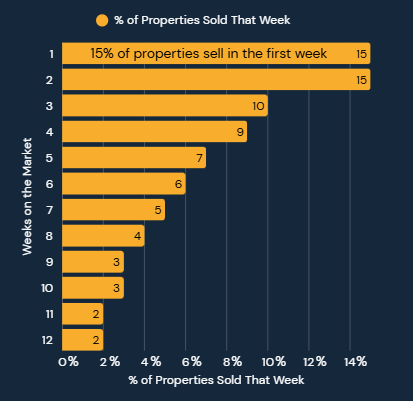
*based on UK property market data and reconstructed market performance analysis using insights from Rightmove, Zoopla and TwentyEA from 2021 - 2026.
What the Data Shows:
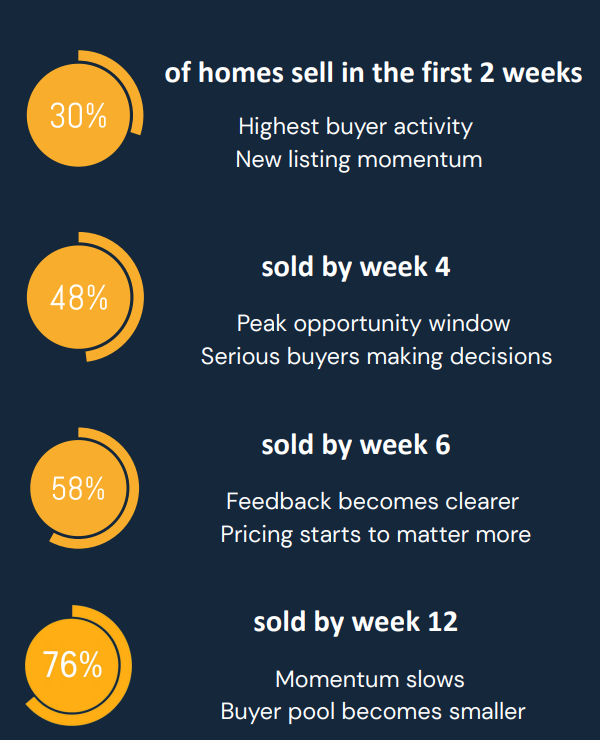
The Truth About Selling Your Home
Most homes don’t sell over time…
They sell at the start or they struggle later
What really happens on the market:
After 12 weeks, only 14-15% of the remaining properties will go on to sell - just 1 in 7!
What This Means For You:
If your home hasn’t sold in the first few weeks:
You’ve already missed your biggest opportunity window
The number of active buyers starts shrinking
Buyers begin to ask: “Why hasn’t this sold yet?”
What Happens After 12 Weeks?
If a property has not agreed a sale within the first 12 weeks, it is usually a sign that a significant change is needed to re-engage buyers.
Rightmove often recommends that any price adjustment should be meaningful — typically around 5% — to attract fresh interest and encourage buyers who may have previously overlooked the property.
However, pricing decisions should never be based on time alone. Any changes should also take into consideration the market data, buyer feedback, viewing levels, and overall response collected since the property first went live. This allows the strategy to be reviewed properly and ensures any adjustments are made with purpose, not panic.
Simply leaving a property to stagnate on the market is often the worst strategy.
What Most Sellers Don’t Realise.
Homes that don’t sell early, often:
Get less interest over time
Require price reductions
End up selling for less than they could have achieved
The best offers usually come early.
That’s because:
New listings create urgency
Buyers compete when interest is high
Strong demand = stronger prices
Simple Way to Think About It:
You don’t get more buyers over time - you get fewer. Your first 4 weeks on the market will determine your final sale price.
The Biggest Mistake Sellers Make.
Starting too high and “testing the market”
What actually happens:
You miss the early wave of serious buyers
Your listing becomes “stale”
You end up reducing later - often below where you could have started
According to research by Zoopla in 2026, when surveying sellers whose homes didn’t sell in the last 3 years, 34% admitted their home was listed at too high a price.
Among those who sold, 53% had to reduce their asking price to attract a seller.
Additional data shows that for every 5% homes were priced over the local market average, their chance of selling reduced by 5%.
Homes 10% over the local market average were 10% less likely to sell.
This data goes to show the importance of pricing right from the start and that, when you reduce the price, you reduce the probability of selling (versus the probability of starting at the right price.
Not only will this help you attract more potential buyers and boost your chance of a sale, it also helps you sell faster.
What happens if I price my property too low?
Pricing your property slightly lower than expected may sound risky but it can be an effective strategy.
A lower asking price can attract more buyers, generate greater interest and lead to more viewings. With more buyers competing for the property, this can result in multiple offers and even push the final sale price higher.
An experienced estate agent will give buyers enough time to view the property before inviting them to submit their best and final offers. This creates a fair and competitive process, where buyers put forward their strongest offer.
The highest offer isn't always the best one. Sellers often choose buyers who are in a stronger position to proceed, such as those who are chain-free or have finances in place.
A good agent will also keep backup buyers engaged in case the agreed sale falls through, helping to keep your move on track.
While pricing too low isn't right for every property, it can be a strategy worth considering alongside other methods of sale, including auction.
Final message from the founder.
When your home first comes to the market, it gets the most attention from serious buyers. In fact, nearly half of all successful sales happen within the first 4 weeks. This is when buyer demand is at its highest and when you have the best chance of achieving a strong price. After this, interest usually starts to slow down. By around 6 weeks, most active buyers have already viewed the property, and by 10–12 weeks, many of the homes that are going to sell have already done so.
That’s why pricing your home correctly from day one is so important. Starting too high can mean missing the most important window of buyer interest, which can lead to fewer viewings, longer time on the market, and price reductions later on. In the current market, starting lower can be the best strategy for a motivated homeowner to get sold, without sacrificing the final sale price.
If you want to try launching at a higher price point, ask us about testing it on seeitherefirst.co.uk, before your listing hits the major national portals. This gives us a window to test demand at a price point before it negatively impacts your overall results.
When you list with Bayzos, we use our Guide to Property Performance, which is built around the first 12 weeks of your sale. This allows our team to stay proactive, monitor feedback closely, and make sure we maximise the most important weeks of your property being on the market.
Thank you for reading.
Gary & The Bayzos Team
Disclaimer:
The statistics and market trends shown in this guide are based on UK property market data and reconstructed market performance analysis using insights from Rightmove, Zoopla and TwentyEA, covering the period from January 2021 to May 2026.
Figures are intended as a general guide to typical market behaviour and may vary depending on location, property type, price range, and market conditions.
For example, homes priced above £750,000 often take longer to sell, as they rely on finding a more specific buyer and the buyer pool is naturally smaller. Around 55–60% of successful sales are agreed within the first 12 weeks.